

Mattifying Skin Care Products Market to Reach USD 24.7 Billion by 2036 on Regimen-Led and Compliance-Driven Growth
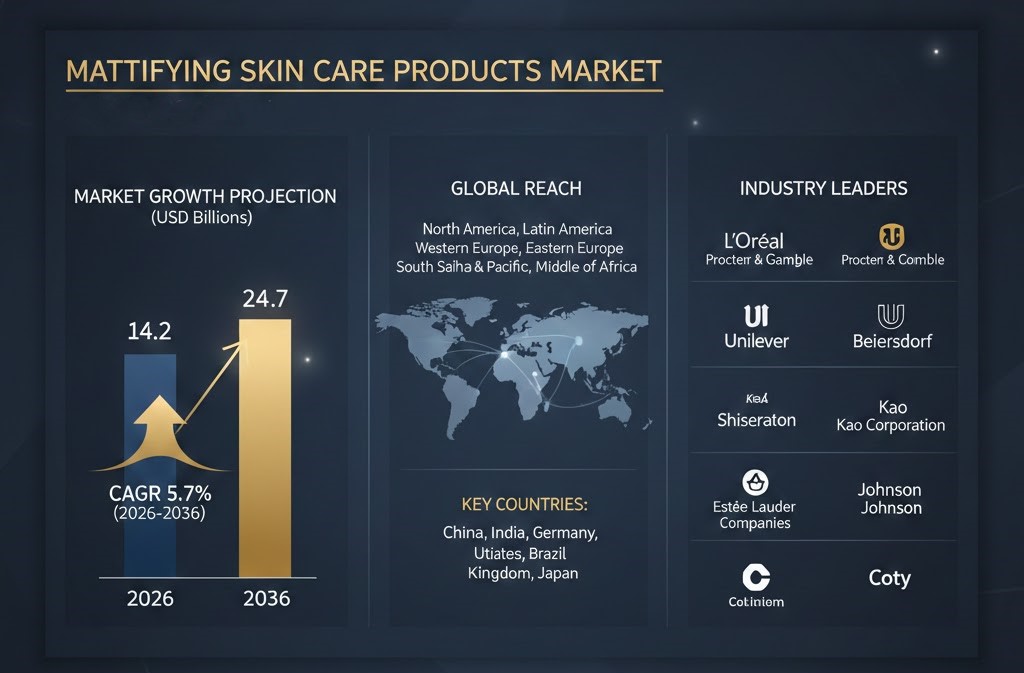
Mattifying Skin Care Products Market
Global mattifying skincare demand rises as oil-control shifts into daily facial routines, with growth led by scalable, compliance-ready beauty platforms.
NEWARK, DE, UNITED STATES, February 10, 2026 /EINPresswire.com/ -- The global Mattifying Skin Care Products market is projected to expand from USD 14.2 billion in 2026 to USD 24.7 billion by 2036, registering a compound annual growth rate (CAGR) of 5.7%, according to analysis by Future Market Insights (FMI). Growth is being shaped less by cosmetic novelty and more by the structural integration of oil-control performance into daily facial care routines, alongside rising regulatory and compliance requirements across major global markets.
The category comprises leave-on facial skincare—mattifying creams, lotions, gels, skincare-grade powders and hybrid primers—formulated to control sebum and reduce visible shine as part of daily routines. Positioned as skincare rather than colour cosmetics, these products are sold through online marketplaces, pharmacies, specialty beauty retailers and mass-market chains across North America, Europe, Asia-Pacific, Latin America and the Middle East & Africa.
FMI projects 2026–2036 growth will be driven by large beauty groups scaling moisturiser-centric platforms while meeting tighter regulatory requirements in the US, EU, China and other key markets, with expansion tied to portfolio renovation, channel penetration and compliance-led product continuity.
Request For Sample Report | Customize Report |purchase Full Report - https://www.futuremarketinsights.com/reports/sample/rep-gb-27251
Market Overview:
The market covers leave-on facial skincare formulations—including creams, lotions, gels, skincare-positioned powders, and hybrid primers—designed to manage visible oil and shine as part of a daily skincare regimen. These products are positioned as skincare rather than color cosmetics and are distributed through online retail, pharmacies, specialty beauty stores, and mass retail channels across North America, Europe, Asia-Pacific, Latin America, and the Middle East & Africa.
Between 2026 and 2036, market expansion will be driven by large-scale beauty and personal care groups that are reinforcing moisturiser-led facial care platforms, while simultaneously meeting tightening regulatory expectations in the United States, Europe, China, and other regulated markets. FMI links category growth to portfolio renovation discipline, channel expansion, and compliance-driven product continuity across global retail systems.
Market Context: Skincare Platforms and Regulatory Pressure
Major beauty companies are increasingly positioning mattifying benefits within broader dermatology-adjacent skincare systems. In 2024, L’Oréal reported like-for-like growth of 5.1%, citing outperformance versus the global beauty market and reinforcing the role of facial care as a core growth engine. Similarly, Procter & Gamble’s 2024 annual report highlighted execution discipline as central to meeting or exceeding organic sales growth guidance, underscoring the importance of integrated portfolio strategies.
At the same time, regulatory compliance intensity is rising. In the United States, the Modernization of Cosmetics Regulation Act of 2022 (MoCRA) expands requirements around facility registration and product listing, increasing compliance overhead and raising the operational bar for skincare producers. Comparable frameworks in the European Union, the United Kingdom, China, India, and Brazil are reinforcing documentation, safety assessment, and claim substantiation expectations. These dynamics increasingly favor scaled operators with repeatable compliance systems and stable product platforms.
Key Growth Insights and Segment Leadership
According to FMI projections:
Mattifying creams will lead the market in 2026, accounting for 34.7% of total revenue, due to their role as the default daily-use base layer in facial care routines across mass and premium tiers. Cream formats allow brands to integrate multiple performance claims—such as moisturization, oil control, and pore appearance—within a single, high-volume SKU.
Oily skin represents the largest skin-type segment, holding a 46.3% share in 2026. This dominance reflects repeat-driven purchase behavior and faster performance evaluation cycles, which support higher replenishment intensity and online conversion.
From a geographic perspective, China is expected to be the fastest-growing national market, expanding at a 7.6% CAGR through 2036. Growth is supported by tighter cosmetics supervision under the national regulatory framework, which increases the advantage of brands capable of sustaining rapid filing discipline and claim substantiation at scale.
Regional Outlook: Where Growth Will Concentrate
Beyond China, FMI identifies India (7.1% CAGR), Germany (6.5%), Brazil (5.9%), the United States (5.4%), the United Kingdom (4.8%), and Japan (4.2%) as core contributors to global growth.
India’s expansion is linked to formalization under the Cosmetics Rules, 2020 and BIS-aligned labeling, strengthening organized retail and repeat-purchase facial care routines.
Germany’s growth reflects EU-grade compliance discipline combined with a strong dermo-skincare manufacturing base.
In the United States, MoCRA-driven supplier consolidation is reshaping retailer sourcing toward compliance-ready portfolios with mature quality systems.
Brazil’s market is anchored by ANVISA governance, which filters demand toward documented, high-throughput facial care lines.
Japan’s slower growth reflects a mature market shaped by domestic incumbents and technology-led skincare renovation, including ongoing formulation investment by leading players.
Competitive Landscape and Industry Implications
The competitive landscape is led by L’Oréal, followed by multinational groups such as Procter & Gamble, Unilever, Beiersdorf, Shiseido, Kao Corporation, Estée Lauder Companies, Johnson & Johnson, Coty, LG Household & Health Care, and Amorepacific. Leadership varies by region, with global scale favoring compliance-heavy markets, while domestic platforms retain influence in Japan and parts of Asia.
FMI emphasizes that the future of the mattifying skin care products market will be governed by the interaction of regimen-led skincare adoption, regulatory compliance capability, and scalable brand execution, rather than short-term cosmetic trends. As compliance costs rise and retailers prioritize supplier reliability, growth is expected to concentrate around fewer, high-volume platforms that can sustain both performance claims and regulatory scrutiny across global markets.
Browse Related Insights
Skincare Products Market : https://www.futuremarketinsights.com/reports/skincare-products-market
Men’s Skincare Products Market : https://www.futuremarketinsights.com/reports/mens-skincare-products-market
Healing Skin Care Products Market : https://www.futuremarketinsights.com/reports/healing-skin-care-products-market
Soothing Skin Care Products Market: https://www.futuremarketinsights.com/reports/soothing-skin-care-products-market
About Future Market Insights (FMI)
Future Market Insights, Inc. (FMI) is an ESOMAR-certified, ISO 9001:2015 market research and consulting organization, trusted by Fortune 500 clients and global enterprises. With operations in the U.S., UK, India, and Dubai, FMI provides data-backed insights and strategic intelligence across 30+ industries and 1200 markets worldwide.
Sudip Saha
Future Market Insights Inc.
+1 347-918-3531
email us here
Legal Disclaimer:
EIN Presswire provides this news content "as is" without warranty of any kind. We do not accept any responsibility or liability for the accuracy, content, images, videos, licenses, completeness, legality, or reliability of the information contained in this article. If you have any complaints or copyright issues related to this article, kindly contact the author above.
