

Pet Toys Market to Reach USD 9.3 Billion by 2036 at 6.9% CAGR Driven by Repeat Purchase Demand
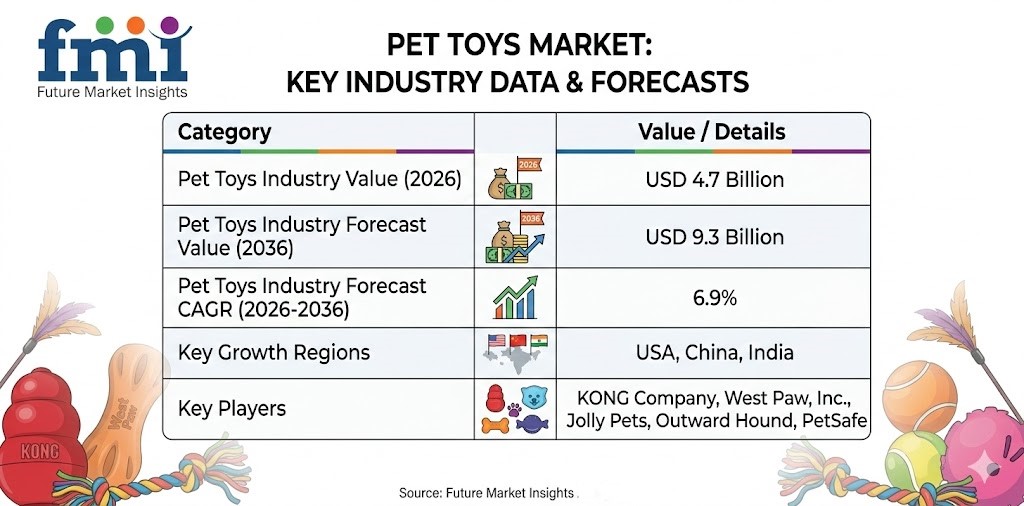
Pet Toys Market
Rising pet ownership and durable chew toy demand drive steady growth across specialty retail and online channels through 2036.
NEWARK, DE, UNITED STATES, February 27, 2026 /EINPresswire.com/ -- The global pet toys market is projected to grow steadily over the next decade, expanding from USD 4.7 billion in 2026 to USD 9.3 billion by 2036, registering a CAGR of 6.9%, according to the latest analysis by Future Market Insights (FMI).
Growth is being shaped by sustained expansion in global pet ownership, rising per-pet spending across enrichment-led categories, and stronger assortment planning discipline across specialty retail and online channels. Demand remains resilient due to repeat-driven purchasing behaviour and comparatively frequent replacement cycles across core dog toy formats.
Pet Toys Market Snapshot (2026–2036)
• Market size in 2026: USD 4.7 billion
• Market size in 2036: USD 9.3 billion
• CAGR (2026–2036): 6.9%
• Leading product type: Chew Toys (~36.0% share)
• Leading sales channel: Specialty Pet Stores (~41.0% share)
• Leading pet type: Dogs (~52.0% share)
• Key growth regions: USA, China, India
Request For Sample Report | Customize Report |purchase Full Report - https://www.futuremarketinsights.com/reports/sample/rep-gb-12550
Market Momentum
The pet toys market begins at approximately USD 4.7 billion in 2026 and maintains a consistent upward trajectory throughout the forecast period. By 2031, structured portfolio segmentation, improved replenishment planning, and premium mix execution across specialist retailers push category value significantly higher.
Between 2031 and 2036, growth accelerates as manufacturers strengthen SKU rationalization, enforce tighter channel governance, and scale durable high-velocity chew and interactive formats. By 2036, the market reaches USD 9.3 billion, sustaining a 6.9% CAGR over the decade.
Why the Market Is Growing
Market expansion is being sustained by normalization of routine toy purchases within monthly pet care baskets and stronger portfolio discipline across retail networks. Purchase frequency remains high in core dog toy categories, where replacement behaviour is driven by wear, enrichment cycles, and seasonal refresh patterns.
Manufacturers are prioritizing:
• Durability-led positioning
• Material and mold standardization
• Controlled variant expansion
• Predictable production runs
• Consistent packaging and shelf-readiness
Retailers are increasingly emphasizing packaging consistency, replenishment reliability, and curated assortment depth—particularly in specialty pet store networks where conversion is strongly influenced by premium presentation and guided purchasing.
Revenue quality is improving as brands reduce low-velocity novelty SKUs and prioritize scalable core lines that protect manufacturing efficiency and retailer confidence.
Segment Spotlight
Product Type: Chew Toys Lead with ~36.0% Share
Chew toys dominate category revenue due to consistent repeat purchasing and strong relevance across dog-owning households. Retailers prioritize durable core lines with predictable sell-through, reinforcing replenishment depth and stable pricing execution.
Interactive, plush, rope, and ball formats complement category expansion but remain structured around inventory discipline and portfolio efficiency.
Sales Channel: Specialty Pet Stores Anchor 41.0% Share
Specialty pet stores retain channel leadership despite online growth. Their advantage lies in curated planograms, premium mix execution, and brand visibility. These outlets enable faster adoption of differentiated lines where pricing integrity and guided purchasing support conversion stability.
Online channels continue to scale, but structured channel governance and promotional discipline are becoming increasingly important to prevent price erosion.
Pet Type: Dogs Capture ~52.0% Share
Dogs remain the primary demand engine due to higher toy consumption frequency and broader penetration across households. Brands prioritize dog-focused assortments, emphasizing durability, repeat purchase continuity, and structured launch calendars that refresh assortments without destabilizing inventories.
Regional Growth: USA, China, and India Drive Expansion
Growth outlook varies by pet ownership density, premium spending behaviour, and retail channel maturity.
• China (7.6% CAGR): Expansion supported by urban pet ownership growth, improved organized retail access, and strong online execution.
• India (7.3% CAGR): Rising household pet adoption and expanding specialty retail networks strengthen enrichment-led category demand.
• USA (7.0% CAGR): Mature replacement-driven purchasing and premium specialty retail infrastructure sustain steady growth.
• Germany (6.7% CAGR): Quality-led purchasing behaviour and structured assortment governance support consistent expansion.
• United Kingdom (6.6% CAGR): Stable pet ownership and strong online repeat purchasing maintain momentum.
Drivers, Opportunities, Trends, Challenges
Drivers:
• Rising per-pet spending
• Structured replenishment cycles
• Durability-led product positioning
Opportunities:
• Portfolio tiering and SKU optimization
• Premium mix expansion in specialty retail
• Improved supply chain predictability
Trends:
• Tighter channel governance
• Material documentation readiness aligned with global compliance frameworks
• Reduced SKU fragmentation
Challenges:
• Pricing discipline across digital marketplaces
• Compliance complexity across global regions
• Inventory control and return management in high-volume SKUs
Competitive Landscape
The pet toys market features a competitive landscape shaped by specialist durability-focused brands and diversified pet product manufacturers. Market leadership increasingly depends on portfolio discipline, reliable replenishment capability, and structured channel frameworks.
Leading companies include:
• KONG Company
• West Paw, Inc.
• Jolly Pets
• Outward Hound
• PetSafe
• SodaPup
• Goughnuts
• Nylabone
• Chuckit
• Planet Dog
These players are investing in structured tiering across chew, interactive, plush, rope, and ball formats, supported by predictable launch cycles and stronger retailer collaboration.
Frequently Asked Questions (FAQs)
1. How large is the pet toys market in 2026?
The global pet toys market is estimated to be valued at USD 4.7 billion in 2026.
2. What will be the market size by 2036?
The market is projected to reach USD 9.3 billion by 2036.
3. What is the expected CAGR between 2026 and 2036?
The pet toys market is expected to grow at a CAGR of 6.9% during the forecast period.
4. Which product type leads the market?
Chew toys are expected to lead, accounting for approximately 36.0% of total market share in 2026.
5. Which pet type drives the highest demand?
Dogs dominate demand, representing about 52.0% of total market share in 2026.
Why FMI: https://www.futuremarketinsights.com/why-fmi
Explore More Research Reports By FMI
Lip Care Market: https://www.futuremarketinsights.com/reports/lip-care-market
Alpha-Arbutin Market: https://www.futuremarketinsights.com/reports/alpha-arbutin-market
Smart Kitchen Appliances Market: https://www.futuremarketinsights.com/reports/smart-kitchen-appliances-market
About Future Market Insights (FMI)
Future Market Insights, Inc. (FMI) is an ESOMAR-certified, ISO 9001:2015 market research and consulting organization, trusted by Fortune 500 clients and global enterprises. With operations in the U.S., UK, India, and Dubai, FMI provides data-backed insights and strategic intelligence across 30+ industries and 1200 markets worldwide.
Sudip Saha
Future Market Insights Inc.
+1 347-918-3531
email us here
Legal Disclaimer:
EIN Presswire provides this news content "as is" without warranty of any kind. We do not accept any responsibility or liability for the accuracy, content, images, videos, licenses, completeness, legality, or reliability of the information contained in this article. If you have any complaints or copyright issues related to this article, kindly contact the author above.
