

MLC Dharmendra Bhardwaj announces Meerut Artisan Outreach for Vishwakarma Day
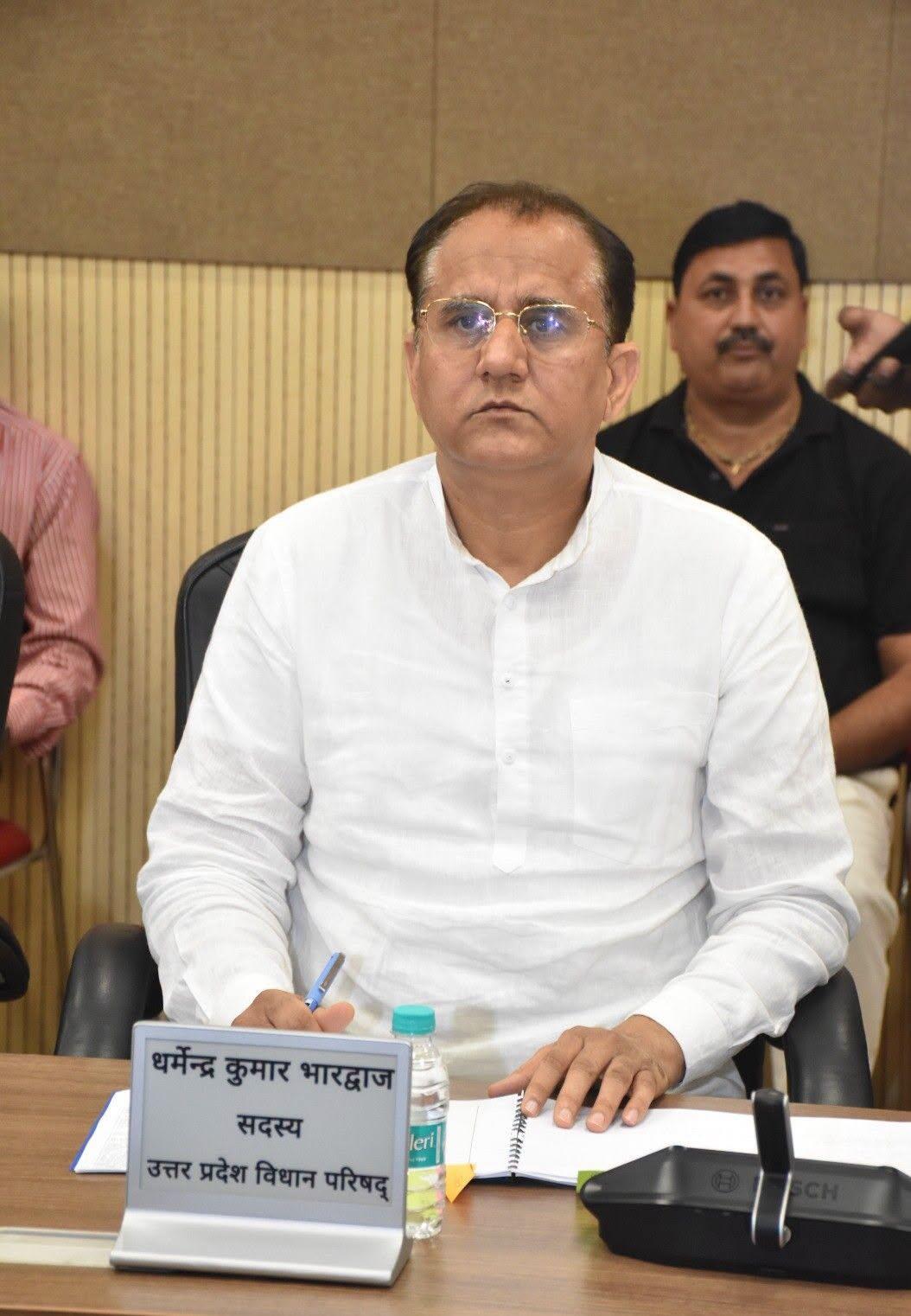
MLC Dharmendra Bhardwaj
On Vishwakarma Day MLC Dharmendra Bhardwaj launches an outreach to enrol Meerut artisans in PM Vishwakarma with ₹15,000 toolkits across five craft trades.
MEERUT, UTTAR PRADESH, INDIA, September 17, 2026 /EINPresswire.com/ -- On the eve of Vishwakarma Puja, MLC Dharmendra Bhardwaj, Member of the Uttar Pradesh Legislative Council from the Meerut-Ghaziabad Local Authorities constituency, announced the launch of the Meerut Vishwakarma Artisan Outreach — a constituency-level programme to onboard the district's traditional artisans onto the Pradhan Mantri Vishwakarma scheme launched by Prime Minister Narendra Modi on 17 September 2023. The Outreach targets Meerut's base of 1,58,561 registered micro, small and medium enterprises, which employ 59,710 workers, generate a combined annual output of ₹1,188 crore and carry an outstanding loan exposure of ₹259 crore.
The Outreach is the artisan-livelihoods complement to two programmes Dharmendra Bhardwaj MLC launched earlier this year: the Viksit Meerut 2027 charter (17 August 2026) and the Western UP Sports Industry Council (convened 27 August 2026). Together, the three programmes constitute an integrated constituency-development platform — aligned with the Prime Minister's Viksit Bharat 2047 framework and the Uttar Pradesh Government's MSME-development agenda, and aimed at converting Meerut's centuries-old artisan heritage into a structured livelihoods engine that reaches craftsmen across all 90 municipal wards and all 12 tehsils of the district.
Why this week matters to Meerut's workshops. Vishwakarma Puja, observed on 17 September across India's industrial belts, honours Lord Vishwakarma — the divine architect, craftsman and patron of artisans. The day carries particular weight in Meerut, where the sports-goods cluster, the Kainchi Bazaar scissors smiths, one of Asia's largest gold markets, the leather-working trades and a dense carpentry and metalworking economy together represent the single largest concentration of traditional artisan livelihoods in western Uttar Pradesh. The Puja also marks the third anniversary of the Pradhan Mantri Vishwakarma scheme, launched by Prime Minister Modi on 17 September 2023 to formalise and dignify eighteen traditional trades that have for generations operated outside the structured credit and skill ecosystem. For a city whose identity is inseparable from its workshops, the anniversary is not ceremonial: it marks three years in which the machinery of formal recognition — identity, toolkit, skill certification, collateral-free credit — has existed at national scale, waiting to be carried into every mohalla that still works by hand.
"The blessing of Vishwakarma is in the hands of every Meerut artisan — the one who crafts a cricket bat, the one who sharpens a scissors blade, the one who shapes gold jewellery, the one who stitches leather. Development is our political dharma, and the artisan is Meerut's backbone. Sabka Saath, Sabka Vikas," said MLC Dharmendra Kumar Bhardwaj.
The scheme at the foundation. The Pradhan Mantri Vishwakarma scheme recognises and supports eighteen traditional trades: carpenter, boat maker, armourer, blacksmith, hammer and tool kit maker, locksmith, goldsmith, sculptor and stone carver, potter, cobbler, mason, basket/mat/broom maker (coir weaver), doll and toy maker, barber, garland maker, tailor, fishing net maker and washerman. Each enrolled artisan receives a recognised artisan identity card and certificate, a toolkit incentive of ₹15,000, skill verification followed by basic and advanced training with a daily stipend, a collateral-free enterprise-development loan — a first tranche of ₹1 lakh repayable over eighteen months, followed by a second tranche of ₹2 lakh repayable over thirty months, up to ₹3 lakh in total at a concessional 5 per cent rate of interest — incentives for digital-transactions adoption, and brand-building support including quality certification and market linkage. The scheme is administered by the Ministry of Micro, Small and Medium Enterprises as a Central Sector scheme, with registration through Common Service Centres and the India Post network. The design is deliberately sequenced. Recognition comes first — the artisan identity card converts an informal practitioner into a registered enterprise in the government's own records. The toolkit incentive follows, upgrading the instruments of the trade itself. Skill training then raises productivity and safety, the enterprise-development loan replaces the moneylender with a formal lender, and the digital-transactions incentive brings the artisan into the formal economy's payment rails. Brand-building and market linkage complete the journey from workshop to marketplace.
The first pillar: sports goods. Meerut is the One District One Product hub for sports goods in Uttar Pradesh. The cluster produces 40–45 per cent of India's sports-goods exports, employs an estimated 3.15 lakh workers across 9,878 registered units, turns over ₹1,500–1,750 crore annually and exports to more than 100 countries. The flagship manufacturers — Sanspareils Greenlands (established 1931), BD Mahajan & Sons (established 1925 in Sialkot, relocated to Meerut after Partition), Sareen Sports Industries (established 1969, founded by N.K. Sareen) and Bhalla International (the five-brother enterprise behind the VINEX brand) — anchor a long tail of household-scale workshops in which Hindu Jatav leather workers and Muslim Ansari weavers work side by side. The sports-goods pillar is the largest single beneficiary of the Outreach. Its scale explains why: no other single trade in the district combines this depth of registered units, this breadth of export destinations and this length of supply chain — from component workshops to export houses — and none depends more heavily on hand skills that formal credit has historically bypassed.
The second pillar: the scissors of Kainchi Bazaar. Meerut's Kainchi Bazaar carries a heritage of scissors manufacture reaching back some 360 years, with historical exports to markets including Burma and Singapore. The cluster holds Geographical Indication application no. 389. As of 2016, the industry was shutting down, unable to compete with mass-produced alternatives; the scissors smiths are hand-makers who work recycled materials — molded, hammered, welded, ground and polished — into finished blades. They are the second-priority beneficiary of the Outreach, and the programme integrates directly with the GI-revival commitment Dharmendra Kumar Bhardwaj MLC announced on 25 August 2026. Geographical Indication protection matters to this trade because the Kainchi Bazaar name itself is the cluster's principal commercial asset: it certifies provenance and hand-make authenticity in a market flooded with mass-produced alternatives, and it gives the smiths a collective brand that no individual workshop could build alone.
The third pillar: gold and jewellery. Meerut hosts one of Asia's largest gold markets, with the Sarafa Bazaar and its allied jewellery workshops employing thousands of goldsmiths, polishers and stone-setters. The Vishwakarma scheme's goldsmith trade category applies directly to this pillar, and the Outreach will work with the Sarafa Association to onboard traditional goldsmiths onto the formal toolkit-and-credit track. These are family-run workshops in which technique passes across generations; their craftsman families stand to gain the most from the goldsmith trade's formal recognition, toolkit support and collateral-free credit.
The fourth pillar: leather goods. The leather-working trades — shoes, bags, sports gloves and military accessories — represent a parallel artisan economy concentrated in the eastern wards of the city. Hindu Jatav and Dalit leather workers, alongside Muslim Mochi and Siddiqui families, constitute the workforce. The Vishwakarma scheme's cobbler trade applies to this pillar, and the Outreach will partner with the District Industries Centre, Meerut to ensure inclusive coverage. The pillar also links back to the sports-goods cluster — sports gloves are a shared product line — so a leather worker enrolled under the cobbler trade can be carried into the same quality-certification and market-linkage track as the sports-goods pillar.
The fifth pillar: carpentry and metalworking. Traditional carpentry, masonry, blacksmithing, locksmith work and stone carving are embedded across Meerut's old-city mohallas, the cantonment belt and the rural hinterland. The Outreach will operate through the 12 tehsils and 663 villages of Meerut district, ensuring that rural artisans are not excluded from formal onboarding. Rural carpenters, masons, blacksmiths and locksmiths typically work the farthest from district-level scheme offices; the tehsil-and-village delivery design exists precisely so that distance from the city centre does not become distance from the scheme.
How the Outreach will work. The programme moves through six workstreams. Under enumeration and onboarding, a ward-wise artisan enumeration — conducted in partnership with the Meerut Municipal Corporation (90 wards after the 2023 delimitation) and the 12 Block Development Officers — will produce the first integrated artisan registry for the district, with targets of 50,000 artisans enrolled on the PM Vishwakarma portal by 31 December 2026 and 1,00,000 by 31 March 2027. The registry is the programme's backbone: no enumeration, no outreach — credit targets, toolkit logistics and training calendars all depend on knowing who the artisans are, where they work and which of the eighteen trades they practise. Under toolkit upgrade, each enrolled artisan receives a PM Vishwakarma toolkit, or an upgrade-grant equivalent, within 60 days of enrolment, distributed through the MSME Tool Room and Development Centre at Meerut (established 1986) and the District Industries Centre field offices.
Under skill training, PMKVY-aligned modules delivered at the MSME-TDC Meerut campus and three satellite locations — Sardhana, Mawana and Partapur — will cover modern technique, quality standardisation, machine-safety and digital-design fundamentals, with a target of 25,000 artisans trained by 31 March 2027. Under the collateral-free credit stack, the Outreach integrates the full ladder of formal credit: the PM Vishwakarma first-tranche loan of ₹1 lakh and second-tranche loan of ₹2 lakh, MUDRA-Shishu loans up to ₹50,000, MUDRA-Kishore loans between ₹50,000 and ₹5 lakh, and MUDRA-Tarun loans between ₹5 lakh and ₹10 lakh — with collateral-free guarantee cover of up to ₹10 crore under the Credit Guarantee Fund Trust for Micro and Small Enterprises, whose ceiling was enhanced from ₹5 crore with effect from 1 April 2025. The target is ₹250 crore in new artisan credit disbursed by 31 March 2027. The ladder is the point. An artisan who has never borrowed formally can begin with the modest first tranche, build a repayment record, and graduate step by step to the larger MUDRA tiers as the workshop grows — with the CGTMSE guarantee removing the collateral barrier that has historically kept informal craftsmen out of the formal credit market entirely.
Under self-employment graduation, the Prime Minister's Employment Generation Programme will be activated for artisans seeking to move from household-workshop scale to micro-enterprise scale, with project-cost assistance of up to ₹50 lakh in the manufacturing sector and margin-money subsidy of 15 to 35 per cent. Under brand-building and market linkage, the Outreach will work with the Sports Goods Export Promotion Council under the Ministry of Commerce — whose secretariat sits at the A-6 Sports Complex, Delhi Road, Meerut, under the chairpersonship of Sumnesh Agarwal — and with the Export Inspection Agency, to deliver quality certification, e-commerce onboarding through Amazon Global Selling, Flipkart Wholesale and the Government e-Marketplace, and buyer-delegation programmes for overseas markets.
A class-neutral programme — every artisan on identical terms. The Outreach is explicitly class-neutral. Meerut's artisan economy crosses every community in the district: Hindu Jatav leather workers, Muslim Ansari weavers, Brahmin goldsmith families, Dalit cobbler and leather trades, OBC carpentry and masonry, and Sikh metalworkers in the cantonment belt. The enumeration and onboarding will use no caste or religion filter — every artisan who qualifies under the eighteen PM Vishwakarma trades is eligible — and the ward-wise enumeration will explicitly cover the Muslim-majority old-city wards (Khairnagar, Dakshini Islamabad, Purvi Islamabad, Shahjahan Colony, Shyamnagar, Kidwai Nagar, Karim Nagar, Tarapuri, Fakhruddin Ali Ahmed Nagar and Zakir Husain Colony), the Dalit-majority Begumpul pockets, and the Hindu-majority wards of Brahmpuri, Indira Nagar, Nehru Nagar and Phoolbagh on identical terms. Class-neutrality here is not an afterthought; it is the operating principle of the enumeration itself. The artisan registry will record trade, ward and workshop — not community — and the programme's success will be measured in artisans enrolled, artisans tooled, artisans trained and artisans financed, with no category of craftsman served ahead of another.
"Meerut's artisan is India's pride. Whether he makes cricket bats, sharpens scissors or sets gold — every artisan deserves respect, credit, a toolkit and a market. Taking Prime Minister Modi's Vishwakarma scheme to every ward and every village of Meerut is our resolve," said MLC Dharmendra Bhardwaj.
About Dharmendra Kumar Bhardwaj: Dharmendra Kumar Bhardwaj is a sitting Member of the Uttar Pradesh Legislative Council from the Meerut-Ghaziabad Local Authorities constituency — elected on 12 April 2022 with 89.61 per cent of the votes polled. He began his career as a chemistry teacher in 1992 and holds an M.Sc. from N.A.S. College, CCS University Meerut (1997) and a B.Ed. from Machra Degree College (1998). He is Chancellor of Motherhood University, Roorkee (since 2019); Chairperson of the Mahaveer Ayurvedic Medical College & Hospital, Meerut; Member of the Board of Management of Sardar Vallabh Bhai Patel University of Agriculture & Technology (SVPUAT), Meerut; and a working-council member of CCS University Meerut. His late father, Mahaveer Bhardwaj, was elected to the Meerut Zila Panchayat from Ward-12 (Sarurpur) in 2010 with 10,451 votes — the third-largest such victory in Uttar Pradesh that year. His term in the Legislative Council runs to 11 April 2028.
Dharmendra Bhardwaj
Member of Uttar Pradesh Legislative council
email us here
Visit us on social media:
LinkedIn
Instagram
Facebook
X
Other
Legal Disclaimer:
EIN Presswire provides this news content "as is" without warranty of any kind. We do not accept any responsibility or liability for the accuracy, content, images, videos, licenses, completeness, legality, or reliability of the information contained in this article. If you have any complaints or copyright issues related to this article, kindly contact the author above.
